Why PVC edging came loose after six months
13 July 2026 · TOOLGINI
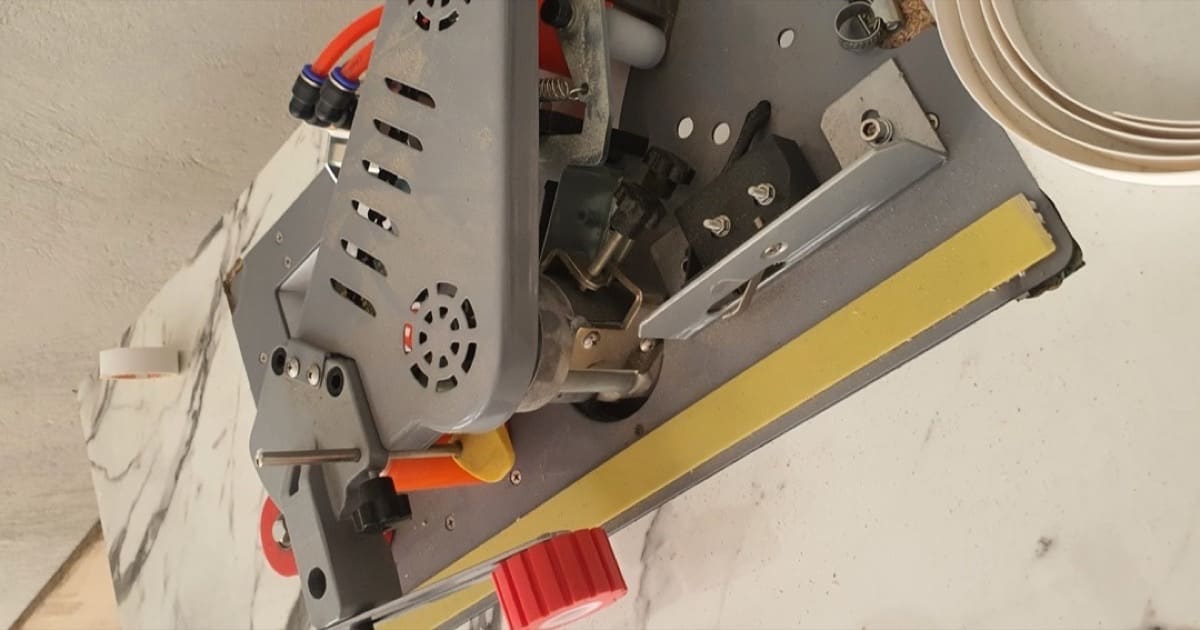
English translation draft for review. The technical wording and product details should be checked against the Greek original before publication.
At a glance
- Preglued edging can be convenient for a few pieces in a dry room, but this job failed in damp conditions
- A glue pot applies fresh EVA hot-melt adhesive at a controlled temperature; check the adhesive maker's settings
- The bench edge bander's guided cutter trims the edging at the end of the workpiece, including on curves
The problem you cannot see at first
A woodworker on an island in the Cyclades bought a small edge-banding machine without a glue pot. “It was cheaper, and all I need to do is apply edging,” he thought. He used preglued PVC edging—the kind with adhesive already on its back that is activated by heat—and quickly finished two kitchens and the cabinets in a holiday rental.
Everything looked good in the first week. The customer was pleased, the work was paid for, and the woodworker moved on to the next job.
Six months later
Winter came and went. On an island, damp is not an abstract concern: you can see condensation on the window in the morning. The edging began to lift, first beside the sink and then elsewhere. The customer called. The woodworker went back, saw the problem, and had to redo the job at his own expense—including the ferry trip and the days of work.
Why preglued edging lifted in this damp setting
Preglued edging arrives with a thin, single layer of hot-melt adhesive on the back. You warm it with an iron or heating tool, press it on and allow it to cool. It can be useful for a few pieces in a dry space or for temporary work.
Three things worked against this particular job:
- Only one thin adhesive layer was available. There was little excess adhesive to fill the pores of the exposed panel edge, or *σόκορο* in workshop Greek.
- Heating was uneven. An iron may not bring all of the adhesive to the temperature needed for good contact. Some spots soften properly; others barely bond.
- MDF and particleboard take up moisture. In a damp room, the exposed panel edge can absorb moisture and swell. The thin bond can then let go, starting at the edge.
The PVC edging itself was not necessarily the problem. The issue was how much adhesive reached the panel edge, at what temperature and for how long. See our guide to why edge banding peels off.
What a glue pot changes
An edge bander with a glue pot melts EVA hot-melt adhesive and maintains its working temperature while the machine runs. Around 180–200°C is one example of a working range; always follow the adhesive manufacturer's specified range for the product in use. As the workpiece passes, a roller applies fresh adhesive to the exposed panel edge. With double application, adhesive reaches both the edging and the panel. The bond no longer depends on the thin factory-applied layer alone.
The difference is in having enough adhesive applied correctly and pressed at the right time, rather than simply choosing an adhesive described as “stronger.”
The bench machine in this story also has a guided end cutter. Its guide shoe helps cut the edging at the end of each piece in the same place, even along a curve. That saves measuring and hand-cutting an extra few millimetres that would later need to be trimmed.
The lesson from this job
- The tempting shortcut: preglued edging looks easier.
- Where it can work: a dry room, a temporary repair or just one or two pieces.
- For damp locations: consider an edge bander with a glue pot, controlled temperature and the right application for the material and adhesive. The machine can apply the adhesive, press the edging and cut it to length.
The result
The woodworker bought a bench edge bander with a glue pot and guided cutter. He remade the cabinets, this time applying fresh adhesive from the pot and pressing the edging while the adhesive was at working temperature. Two winters passed without another call about lifting edging.
Three points to remember
- For this damp-climate job, fresh adhesive from a glue pot proved more reliable than the preglued edging the woodworker had used.
- Application, temperature and pressure mattered as much as the choice of adhesive.
- The guided end cutter trimmed the edging at the workpiece end without measuring each cut, including on curved parts.
Tell us about your job
Have you seen edging lift after a few months? Tell us where it happened and how the adhesive was applied.
Explore our edge banders, from portable models to industrial machines, and compare the functions that matter for your workshop.
Original: read this article in Greek.